

 Share
Share
News
- Home
- News
CUHK Welcomes the ‘Pilot Bowel Cancer Screening Programme’ and Recommends Subsidizing Residents Aged 61-70 First
17 SEP 2014
Recently, bowel cancer has become the most common cancer and the second leading cancer killer in Hong Kong, with about 4,450 new cases and causing 1,900 deaths per year. The Department of Health has started the preparatory work of a pilot programme to subsidize bowel cancer screening for higher risk groups, and is now working out the age groups to be the covered by the programme and operation details. The Chinese University of Hong Kong (CUHK) welcomes the pilot programme, and recommends subsidizing residents aged 61-70 first based on the findings by the CUHK Jockey Club Bowel Cancer Education Centre.
Supported by the Hong Kong Jockey Club Charity Trust, the CUHK Jockey Club Bowel Cancer Education Centre (the Centre) has launched a territory-wide bowel cancer screening programme in May 2008. Until December 2012, a total of 10,732 Hong Kong residents have undergone screening. It was found that more than half (54.6%) chose faecal occult blood test for screening. There was significantly more subjects aged 61-70 years chose faecal tests (75.3%) than those aged 50-60 years (54.0%). The return rate of faecal test, rate of successful faecal collection, and colonoscopy attendance rate were similar across age groups.
Worth noting that participants aged 61-70 years perceived more financial difficulties and poorer accessibility to screening services, yet they had fewer misperceptions and psychological barriers of screening. The detection rate of advanced neoplasia and cancer was much higher in the age group 65-70 years (11.9%) and 60-64 years (6.5%) than younger age groups (3.8% to 5.5%). The costs per life year saved for subjects aged 66-70 years (HK$69,120) and 61-65 (HK$310,636) were significantly lower than those aged 50-60 years (HK$726,196-1,229,828).
CUHK will fully support the HK-wide ‘Pilot Bowel Cancer Screening Programme’ subsidized by the Government, and recommend subsidizing bowel cancer screening to residents aged above 60 years as a pilot is a good start of the Government policy. It is more likely for this age group to uptake screening by faecal test, as they have fewer psychological barriers. At the same time, it is more cost effective for this age group to have bowel cancer screening.
CUHK is now working on several initiatives to provide possible solutions for the society on prevention of bowel cancer and promotion of bowel screening, including priority targeted screening for high-risk people, formulating sustainable financing model for screening and intervention, and enhancing the role of primary care doctors, especially family physicians and nurses, in bowel cancer screening.
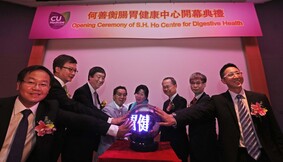
About CUHK S.H. Ho Centre for Digestive Health
To further reduce the health threats due to bowel cancer, the S. H. Ho Centre for Digestive Health is established by the generous donation of HK$17 million from the S.H. Ho Foundation. This centre is equipped with State-of-the-Art medical equipment and aimed to provide high quality gastrointestinal exam services and trainings to health care professionals.
About CUHK Jockey Club Bowel Cancer Education Centre
In May 2008, The Institute of Digestive Disease at CUHK was generously funded with HK$16 million by The Hong Kong Jockey Club Charities Trust to set up the CUHK Jockey Club Bowel Cancer Education Centre. In 2013, an additional HK$16 million were donated to launch another phase of a 5-year bowel cancer education and screening programme.
Source: Communications and Public Relations Office, The Chinese University of Hong Kong
CUHK Receives Donation from HKJC for Teaching Hospital Project and CUHK Jockey Club Institute of Ageing
21 AUG 2014
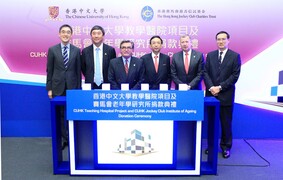
The Chinese University of Hong Kong (CUHK) is pleased to receive a generous donation of HK$1.3 billion from The Hong Kong Jockey Club (HKJC) Charities Trust for the development of the territory’s first not-for-profit and self-financed teaching hospital, which aims to serve the public and enhance the quality of teaching and research. The pioneering initiative will offer a new healthcare model in Hong Kong. This is the largest single donation ever made by HKJC to a medical project in Hong Kong, and is also the greatest single donation ever received by CUHK. In sincere appreciation of HKJC’s support, the University will name one of the clinical blocks of the hospital as The Hong Kong Jockey Club Clinical Tower. In addition, HKJC will further donate HK$12 million to support the establishment of the CUHK Jockey Club Institute of Ageing. A donation ceremony was held today (21 August), officiated by Mr. T. Brian STEVENSON, Chairman of HKJC; Mr. Winfried ENGELBRECHT-BRESGES, Chief Executive Officer of HKJC; Mr. Douglas SO, Executive Director, Charities of HKJC; Dr. Vincent H.C. CHENG, Chairman of the Council of CUHK; Prof. Joseph J.Y. SUNG, Vice-Chancellor and President of CUHK; and Mr. Chien LEE, Chairman of CUHK Medical Centre Governing Board.
Innovative healthcare enterprise driven by social mission
CUHK has been actively planning the development of a CUHK owned, professionally managed, not-for-profit Teaching Hospital on a campus site adjacent to the University MTR station. The project reflects CUHK’s commitment to the Government’s policy to increase the diversity of healthcare provision in Hong Kong in order to alleviate the increasing burden of healthcare falling on the Hospital Authority as Hong Kong’s population ages. Driven by this social mission, the new Teaching Hospital will offer innovative and patient-centered quality healthcare services to local citizens, setting a new milestone in the health system of Hong Kong.
Prof. Joseph J.Y. SUNG, Vice-Chancellor and President of CUHK, said, ‘The Teaching Hospital project is a pioneering initiative to the humble purpose of serving the people of Hong Kong. The new Teaching Hospital is Hong Kong’s first not-for-profit, self-financing university hospital that is wholly-owned by CUHK. The Hospital makes wide use of straight-forward package pricing so that the costs of treatment become transparent and affordable to local middle-class families.’
Mr. T. Brian STEVENSON, Chairman of HKJC, said, 'The teaching hospital will be of particular benefit to the city’s sandwich class, as it will be the first hospital in Hong Kong to offer package prices, helping to bridge the gap between expensive private healthcare and the excellent but overburdened public services.' He added, 'Such packages will offer good quality one-stop healthcare services at affordable prices covering all costs, so that patients can be better informed of the actual expenses to be incurred before receiving treatment. We believe it will be a welcome addition to Hong Kong’s medical and health arena and a major milestone to local medical development.'
Mr. Stevenson told the audience that another key function of the teaching hospital was its senior-friendly facilities, including an Elderly Day Centre to treat those suffering from chronic diseases, dementia and commonplace ailments like eye cataracts. Complemented by the Trust-funded Institute of Ageing, the hospital would help mitigate the challenges brought by an ageing population in the city.
Dr. Vincent H.C. CHENG, Chairman of the Council of CUHK, expressed his gratitude to HKJC for its long-standing support to CUHK, ‘The Jockey Club first donated towards CUHK in 1969. Since then, the Club has donated through its Trust to support close to 40 projects on education and healthcare promotion, campus development and community services. All these demonstrate the Club’s strong commitment to the welfare of the local community.’
Quality healthcare services with patient-centred principles
The Teaching Hospital will operate a new healthcare model that promotes long term sustainability of medical and health services in Hong Kong. It bridges the service gap between private and public healthcare sectors by providing high-quality medical services with transparent and affordable pricing to the middle-class families, alleviating the pressure on the public system. It will provide a full range of inpatient, outpatient, ambulatory diagnostic and treatment services, as well as age-friendly facilities like an elderly day centre for elderly suffering from chronic diseases and cognitive impairment. The hospital will provide integrated clinical services in Emergency Medicine, Family Medicine, Chinese Medicine, General Medicine and Surgery, Orthopaedics, Gynaecology, Paediatrics, Neonatology and Obstetrics. It differs from other private hospitals by serving as a key base for clinical research, healthcare education and training, providing first-class teaching venues and facilities for students, doctors, nurses, pharmacists and allied health workers. This will enable transfer of research and innovation and raise the teaching standards of CUHK Medical Faculty.
Wholly-owned by CUHK without participation of commercial corporations
The Teaching Hospital will cover a total construction floor area of 78,000 m² and will provide around 600 beds, with a number of beds set aside for public patients. The hospital will be wholly-owned by CUHK without the participation of any commercial corporation. Financing consists of donations, the undesignated private fund reserve of the University, and loans. The hospital will be self-financed and financially independent. Any surplus from the Teaching Hospital will be used to support its future development, meet the teaching and research needs of the CUHK Faculty of Medicine and the University.
The CUHK Jockey Club Institute of Ageing
It is expected that in 2030, a quarter of Hong Kong’s population will be aged 65 or above, and the number of people aged 85 or above is projected to increase more rapidly than those aged 65-80. In support of CUHK’s aspiration to overcome the challenges brought by the ageing population to society, HKJC has generously donated HK$12 million to CUHK to establish The CUHK Jockey Club Institute of Ageing, which aims to make Hong Kong an age-friendly city in the world. The institute will synergize the research personnel and efforts across disciplines to promote and implement holistic strategies for active ageing, through research, policy advice, community outreach and knowledge transfer. The Club’s CADENZA Project Director Prof. Jean Woo will serve as the Director of the Institute.
Source: Communications and Public Relations Office, The Chinese University of Hong Kong
Eleven Students from the Faculty of Arts Received
'Sin Wai Kin CUHK Golden Jubilee Scholarship in Arts, History and Philosophy'
21 JUL 2014
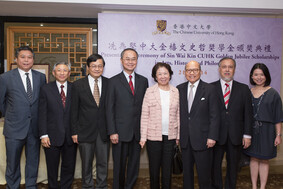
To recognize the outstanding academic achievements of students from the Faculty of Arts, the 'Sin Wai Kin CUHK Golden Jubilee Scholarship in Arts, History and Philosophy' was established by Dr. Sin Wai-kin, David, Chairman of Sin Wai Kin Foundation and Myer Jewelry Manufacturer Limited, in 2013 in the midst of the Golden Jubilee year of The Chinese University of Hong Kong. The first Scholarship Presentation Ceremony was held on 21 July 2014 at the Chung Chi College Staff Club. The Ceremony was officiated by Professor Fok Tai-fai, Pro-Vice-Chancellor and Vice-President, Professor Leung Yuen-sang, Dean of Faculty of Arts, and Dr. and Mrs. Sin Wai-kin. Dr. Sin's family was also invited to attend the Ceremony and meet with the scholarship recipients.
In his welcoming speech, Professor Fok Tai-fai thanked Dr. Sin and his family for their long-standing support to the University. Mr. Sin Nga-yan, Benedict, son of Dr. Sin and Director and General Manager of Myer Jewelry Manufacturer Limited, encouraged the scholarship recipients to aim higher and strive hard to overcome the challenges they may encounter when pursuing their goals. Mr. Sin also inspired students to pursue virtues and actively take part in community services.
Eleven students from the Department of Chinese Language and Literature, English, Translation, History and Philosophy have been selected by the Faculty of Arts to be the recipients of this distinguished award. The awardees carry the prestigious title of 'Sin Wai Kin CUHK Golden Jubilee Outstanding Students in Arts, History and Philosophy'. Awardee Mr. Chau Chun-yin, Dennis represented the scholarship recipients to express their gratitude to Dr. Sin for his generosity in setting up this meaningful award for students of the Faculty of Arts. A thank you card made by the scholarship recipients was presented to Dr. Sin and his family at the end of the Ceremony.